
Understanding Binary Numbers and Their Uses
💻 Explore the basics of the binary number system, its role in digital electronics, methods to convert numbers, and why it's vital in computing and communication 📊
Edited By
Emily Carter
Signed binary numbers play a key role in computer systems by allowing machines to represent both positive and negative values. Unlike unsigned binary, which only covers zero and positive numbers, signed representation expands the number range, making it crucial for real-world calculations and data processing. For instance, banks use signed binary in software to handle transactions that may include both deposits (positive) and withdrawals (negative).
The difference lies in how the highest-order bit (leftmost bit) is used. This bit acts as a sign indicator — typically 0 for positive numbers and 1 for negative numbers. This simple trick helps computers interpret binary data correctly across arithmetic operations.
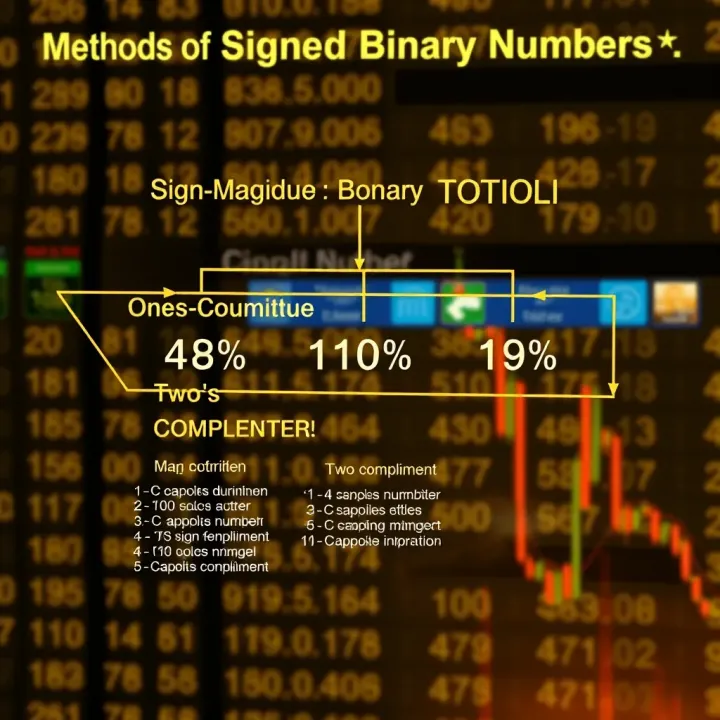
Common methods to represent signed binary include:
Sign-and-Magnitude: The first bit shows the sign, while the rest represent magnitude. It is intuitive but complicates arithmetic since addition and subtraction require extra handling of signs.
One’s Complement: Negative numbers come from flipping all bits of their positive counterpart. Although this eases some calculations, it leads to two representations for zero, which can be confusing.
Two’s Complement: Widely adopted in modern systems, this method forms negative numbers by inverting bits and adding one. It simplifies arithmetic operations and eliminates the dual-zero problem.
Two’s complement stands out because it allows computers to add and subtract signed numbers using the same binary addition rules as unsigned numbers.
Understanding these methods is important not only in software development but also in hardware design, where efficient number representation impacts processing speed and power consumption. For example, financial traders analysing stock price changes rely on signed binary arithmetic for accurate calculations of gains and losses.
By grasping how signed binary works, students, engineers, and IT professionals can better comprehend how digital circuits and programming languages handle negative values, leading to more robust code and systems.
Signed binary numbers are a way to represent both positive and negative integers in digital systems. Unlike regular binary numbers, which only express non-negative values, signed representations include a special method to indicate whether a number is negative or positive. This makes them essential in computing, where calculations often involve negative values—for example, tracking debts in financial software or representing temperatures below zero in meteorological data.
The core value of signed binary numbers lies in their ability to fit into existing binary systems while expanding their range. A common method uses the leftmost bit as a sign indicator—0 for positive and 1 for negative—making it easier for hardware and software to interpret the overall value. This practical approach avoids the complexity of having separate systems for positive and negative numbers, ensuring smooth operation in day-to-day computations.
Unsigned numbers only represent zero and positive integers, so their range extends from 0 up to a maximum value determined by the number of bits. For example, an 8-bit unsigned number ranges from 0 to 255. This limitation poses an issue when negative values are required, as in financial ledgers or temperature readings.
Signed numbers, however, split the range to cover both positives and negatives, typically Centreing zero. Using the earlier example, an 8-bit signed number usually covers from –128 to +127. This dual range allows programmers and systems to handle loss, debt, or any other negative value naturally within the same binary format. Without signed representation, handling negative values involves extra software logic or more complex hardware, which slows down processing.
Many real-world problems need representation of negative numbers, especially in financial calculations or control systems. For example, a banking app calculating account balances must handle withdrawals (as negative numbers) and deposits (positive numbers). Using signed binary numbers simplifies such tasks because the computer can use the same format for both positive and negative amounts, avoiding separate handling mechanisms.
Digital devices like microcontrollers rely heavily on signed binary numbers to adjust parameters such as temperature or motor speed below or above zero value points. This not only streamlines device programming but also reduces errors caused by misinterpreting negative values.
Signed binary numbers are fundamental in nearly every computing task involving arithmetic operations. Arithmetic units in processors, including those in Pakistan-made electronics or imports like laptops, depend on signed representations to perform addition, subtraction, multiplication, and division correctly.
Without a proper signed number system, handling negative results would require extra layers of programming or hardware interpretation, making processes inefficient. For instance, in software that analyses stock market trends on PSX (Pakistan Stock Exchange), signed numbers allow easy calculation of gains and losses, directly influencing investment decisions.
Understanding signed binary numbers helps you grasp how computers manage real-world data effectively, making it a cornerstone concept for students, professionals, and anyone dealing with digital systems.
Signed binary numbers include a sign bit to represent positive and negative values.
They differ from unsigned numbers by covering both sides of zero.
Signed representation simplifies handling of negative values in computing and real-world applications.
Essential for accurate arithmetic and logic operations in hardware and software.
This knowledge is a stepping stone towards mastering computer architecture, embedded systems, and programming, all of which rely on accurate number representations to function properly.
When dealing with signed binary numbers, choosing the right representation method is key. Each method offers a different way of encoding positive and negative values, which affects how arithmetic operations are performed and how effectively hardware and software handle signed data. For instance, the way microprocessors interpret these numbers during calculations depends heavily on the binary format used. Understanding these common methods helps you select the best approach for your computing needs, whether in programming, embedded systems, or digital circuits.

Sign-magnitude representation uses the most significant bit (MSB) to indicate the number's sign: 0 means positive, and 1 means negative. The remaining bits represent the magnitude, or absolute value, of the number. This straightforward setup mimics how humans write signed numbers with a plus or minus sign before a value.
In an 8-bit sign-magnitude number, for example, the MSB shows the sign, and the other 7 bits give the number’s size. This means the range covers values from -127 to +127, with two representations for zero (+0 and -0). The double zero can complicate certain operations like comparisons or arithmetic.
The major advantage of sign-magnitude is its simplicity and directness, making it intuitive to understand. However, its main drawback is the awkward handling of zero and arithmetic operations, since you must treat the sign separately from the value. This often leads to more complex circuits in hardware or code logic in software.
One's complement simplifies negative number representation by inverting all bits of the positive number to get its negative counterpart. To convert +5 (00000101 in 8-bit), flip every bit to get 11111010, which is -5 in one's complement.
This method maintains symmetry around zero but still results in two zeros: all bits zero for +0 and all bits one for -0. Arithmetic mostly involves normal binary addition, but you must handle end-around carry (adding back the overflow bit) to get the correct result.
One’s complement improves on sign-magnitude by making subtraction easier and arithmetic more uniform. Yet, the double zero remains problematic, causing inefficiencies in processing and storage. That’s why it’s rarely used today but historically important.
Two’s complement fixes the issues of the previous methods by defining a unique zero and simplifying arithmetic. To convert +5 to -5 in 8-bit, first get the positive binary (00000101), invert the bits (11111010), then add 1 (11111011). This gives you the two's complement representation of -5.
This approach allows addition and subtraction to use the same circuitry without needing separate sign handling. Overflow detection becomes straightforward, and there is only one zero representation. It streamlines microprocessor design and improves computation speed.
Almost all modern processors use two's complement because of its efficient, consistent arithmetic handling. It reduces hardware complexity and software overhead, making signed operations faster and more reliable. For example, Karachi’s local digital gadgets and even financial software often rely on two’s complement internally when dealing with signed numbers.
Choosing the right signed number representation affects both performance and complexity in computing systems. Two's complement has become standard due to its balance of simplicity and operational effectiveness.
Understanding these encoding schemes helps traders, students, and analysts appreciate how underlying digital calculations work, which is especially beneficial when dealing with complex data processing or system design.
Arithmetic with signed binary numbers is key to handling negative and positive values efficiently in computing tasks. Whether you are a trader analysing financial models or a student working through programming problems, understanding these operations helps you trust your calculations and avoid errors. This section covers methods used to perform addition and subtraction, plus how to detect problems such as overflow and underflow.
When using sign and magnitude representation, the most straightforward method takes the signs into account separately from the magnitudes. For addition, if both numbers have the same sign, you add their magnitudes normally and assign the common sign to the result. However, if the signs differ, you subtract the smaller magnitude from the larger one and assign the sign of the number with the greater magnitude.
For example, to add +5 and -3, you compute |5| - |3| = 2 and give the result a positive sign because 5’s magnitude is greater. This method seems simple, but the separate handling of signs complicates arithmetic circuits and increases processing time, especially when subtracting.
Two's complement representation solves these complications by encoding negative numbers so that addition and subtraction can be handled uniformly. With this system, the same binary addition rules apply regardless of sign. For instance, if you add 5 and -3 in two's complement, the binary addition automatically results in 2 without separate sign handling.
This simplification allows processors to use a single adder circuit for both signed and unsigned operations, improving speed and reducing hardware complexity. That is why two’s complement is the preferred method in modern computers and digital systems.
Overflow happens when a calculation exceeds the range that the signed binary format can represent. For example, in an 8-bit two's complement system, values range from -128 to +127. Adding 100 and 50 results in 150, which cannot be represented in 8 bits, triggering overflow.
Overflow corrupts results silently if undetected, which is critical for financial analysts or data scientists relying on precise computations. Being aware of this limitation ensures you set appropriate data widths or implement error checks.
Processors detect overflow by examining the carry into and out of the sign bit after addition. If these two differ, overflow has occurred. Programming languages or assembly instructions often include flags you can check after arithmetic operations to detect such errors.
Besides hardware detection, software can implement range checks before performing operations. For example, before adding two signed numbers, your code can verify they won’t exceed limits to avoid corrupted results. This is particularly vital in financial modelling or algorithmic trading where accuracy is paramount.
Understanding how overflow and underflow affect signed binary arithmetic helps you design more reliable and faster digital systems, reducing costly mistakes in real-world applications.
By mastering these arithmetic techniques and error detection methods, you can confidently work with signed binary data across various fields, from computer engineering to financial analysis.
Signed binary numbers play an essential role in various digital systems, especially microprocessors and programming environments. Their application impacts how computers interpret data, perform calculations, and carry out instructions. Beyond just theory, understanding where and how signed numbers are used helps in designing better software and hardware solutions.
Signed numbers significantly influence instruction sets in microprocessors. Most modern CPUs, including those used in local computers and smartphones, support arithmetic operations that assume two's complement signed representation. This setup allows the processor to handle positive and negative integers seamlessly with the same hardware units. As a result, instruction sets include operations such as signed addition, subtraction, and multiplication, each tailored to honour the signed nature of the data.
For example, assembly language instructions for arithmetic operations distinguish between signed and unsigned variants (e.g., ADD vs ADDS or SUB vs SUBS), ensuring correct interpretation of negative values. This distinction is critical in applications like financial calculations, where negative balances or losses must be accurately represented.
In programming and hardware, signed numbers determine how data types behave. Languages such as C, Python, and Java provide signed integer types that programmers use to represent negative values. This affects everything from simple counters to complex algorithms involving positive and negative inputs.
At the hardware level, registers and memory locations store signed binary numbers following conventions like two's complement. This uniformity simplifies arithmetic logic unit (ALU) design, enabling efficient computation without extra overhead for sign handling. Furthermore, signed number handling is fundamental for condition flags (e.g., zero, sign, overflow) that guide program control flow based on calculations.
One notable challenge with signed binary numbers is handling range limits. Each representation can only encode values within a fixed span; for instance, an 8-bit two's complement can represent numbers from -128 to +127 only. When operations exceed this range, overflow occurs, leading to incorrect results or wraparounds that programmers and hardware must manage carefully.
This range limit directly influences the choice of data types in software development, especially for financial or scientific applications requiring larger number ranges. Systems often use 16-bit, 32-bit, or 64-bit signed numbers to provide a wider span but at the cost of increased memory usage.
Regarding complexity and performance, signed arithmetic slightly increases hardware design demands compared to unsigned operations. The need to detect and manage overflow or underflow conditions adds logic gates and processing cycles. However, modern microprocessors handle these efficiently through optimised pipelines and dedicated circuitry.
Still, for extremely performance-sensitive tasks like high-frequency trading or real-time data processing, even minor delays matter. Developers need to balance between correct signed data handling and speed by selecting appropriate numerical representations and optimising code accordingly.
The practical use of signed binary numbers hinges on recognising their limits and designing systems that efficiently handle the dual challenge of correctness and performance.
In summary, recognising the applications and practical considerations of signed binary numbers helps professionals make informed choices in both hardware design and software development, ensuring robust and efficient digital systems for the Pakistani tech ecosystem and beyond.
This section sums up the key ideas about signed binary numbers, making it easier for you to remember and apply them. Understanding these basics helps in tasks like programming, designing digital circuits, or analysing data processing systems. For example, knowing whether a signed representation limits the range of values can affect how you design a financial algorithm that handles both profits and losses.
Signed binary numbers come in different forms, each with its own trade-offs. Sign-magnitude uses a single bit for sign and the rest for magnitude, making it straightforward but cumbersome for arithmetic because subtraction needs special handling. One's complement flips the bits for negative numbers, simplifying negation but causing two representations for zero, which complicates programming. Lastly, two's complement adds one to the one's complement representation; this method is today's standard since it streamlines addition and subtraction without extra logic. For example, the number -5 in an 8-bit two's complement system appears as 11111011, which easily integrates with arithmetic operations.
Selecting the appropriate method depends on your specific use case. If your priority is simplicity in hardware design and performance, two's complement is the best choice due to its arithmetic efficiency. For educational purposes or simpler representations where arithmetic isn't critical, sign-magnitude might be enough. Consider the range of numbers you need to represent: sign-magnitude and one's complement reduce the usable range compared to two's complement. For instance, in microprocessor design where speed and range are crucial, two's complement is the default. In contrast, a simple calculator application might tolerate sign-magnitude if ease of understanding matters more than performance.
Remember, the right choice eases the programming burden and reduces potential bugs linked to overflow and incorrect sign handling.
In general, focus on two's complement for most modern applications, but keep in mind the quirks of the other methods when working with legacy systems or learning fundamentals. Balancing range, complexity, and the specific arithmetic operations you plan to perform will guide you towards the method best suited to your project.
💻 Explore the basics of the binary number system, its role in digital electronics, methods to convert numbers, and why it's vital in computing and communication 📊

Explore how binary numbers operate in tech 📱, understand binary vs decimal, and learn key binary operations powering today's digital devices 💻.

🔢 Understand binary numbers, their structure, and conversions. Explore practical uses in computing, electronics, programming, and everyday tech applications.

Explore binary operations 🔢 in math and computing, understanding their roles in groups, rings, fields, and practical applications in tech and algebra systems.
Based on 9 reviews