

Understanding Binary Files: Uses and Handling
Explore how binary files work, differ from text files, and their practical uses 💾. Learn about data storage, manipulation, and tools to handle them in computing.
Edited By
James Harrington
Extended binary trees offer a more detailed approach to classical binary trees by explicitly representing absent children as external or null nodes. Unlike basic binary trees where nodes might have zero, one, or two children, an extended binary tree treats every internal node as having exactly two children. If a child is missing, it is represented using a placeholder external node, ensuring that the tree maintains a consistent structure.
This clear structural rule helps computer scientists and programmers handle tree operations more predictably. For example, in parsing expressions or managing symbol tables, having a uniform two-child rule removes ambiguity and simplifies algorithms.
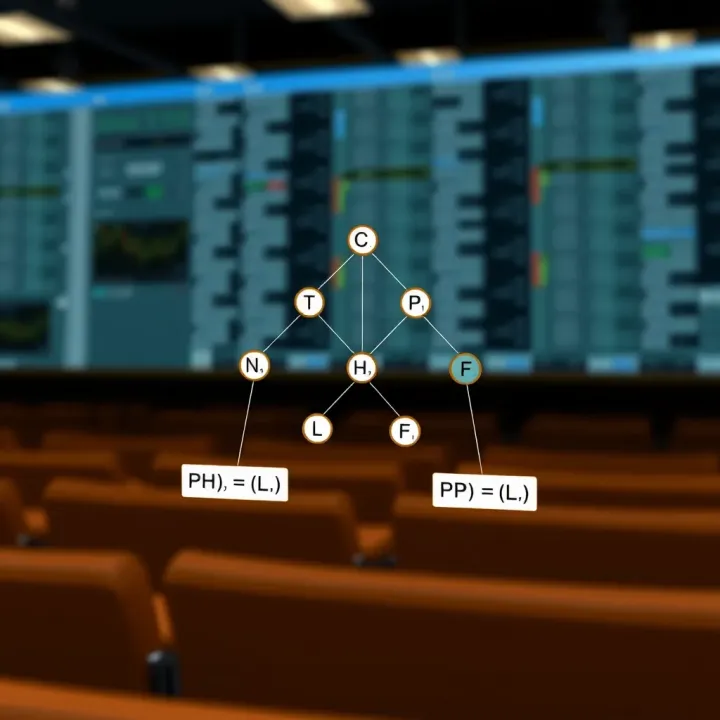
Extended binary trees help in representing incomplete binary trees, offering a systematic way to handle missing links without losing structural information.
To illustrate, consider a binary search tree (BST) with some missing leaves. If you want to convert it into an extended binary tree, each missing child becomes a special external node. This means that the extended tree will have twice the number of internal nodes plus one external node, compared to the ordinary binary tree, which assists with recursive traversals and algorithmic proofs.
In practical applications, extended binary trees find use in:
Expression parsing: They clearly distinguish absent operands in arithmetic expressions.
Memory management: Custom allocators use extended binary trees to track free and allocated memory chunks.
Network routing: The tree structure helps mark unavailable connections as external nodes.
Understanding the core idea behind extended binary trees, which is treating every absent node as an explicit external node, helps traders or analysts who might work with tree-based data structures in software for market simulations or risk modelling. The uniform structure allows algorithms to run cleaner and predictably, which reduces bugs in financial computations or data retrieval.
In summary, extended binary trees provide a way to standardise the binary tree structure, enhancing clarity for both implementation and theoretical analysis. This is especially useful in programming environments where knowing exactly where child nodes exist or do not is essential for reliable operation.
Extended binary trees offer a structured approach to understanding binary trees by ensuring every internal node has exactly two children, even if that means including external or null nodes. This tidy design simplifies the analysis and implementation of binary trees, making it especially valuable for practitioners dealing with data structures. For example, when parsing mathematical expressions, extended binary trees neatly represent operations with clear distinctions between internal and external nodes.
This section introduces the basic structure and importance of extended binary trees. Knowing this foundation helps you grasp more complex topics such as tree traversals and applications in computer science. It also highlights practical benefits, like consistent node patterns that lead to predictable performance in algorithms.
Unlike ordinary binary trees where nodes can have zero, one, or two children, extended binary trees are defined so that each internal node has precisely two children. When a node lacks a child on one side, an external or null node is added as a placeholder to maintain this rule. This distinction means extended binary trees are always full in structure but can have more nodes due to these external placeholders.
This difference is not just structural; it affects how algorithms interact with the tree. For example, in search algorithms or expression parsing, having a consistent two-child rule reduces the need for multiple null checks, simplifying code and sometimes improving efficiency.
Internal nodes in an extended binary tree are those that have two children – either real child nodes or external null nodes. External nodes, on the other hand, represent the absence of a child and are treated as leaf nodes but are explicitly present in the tree’s structure. These external nodes are often viewed as markers indicating where the tree’s branching ends.
Practically, external nodes help in clearly defining tree boundaries and assist in traversal algorithms that require explicit null references. For instance, when conducting an inorder traversal, distinguishing external nodes ensures the traversal correctly handles leaf-level terminations.
The idea of extended binary trees came up in the 1960s during the formal study of data structures, particularly to simplify the way trees are represented and manipulated in computer algorithms. Early computer scientists noticed that standard binary trees led to ambiguity when nodes had missing children, complicating traversal and modification algorithms.
Introducing external nodes was a neat way to solve these problems. It provided a standard where every internal node behaves predictably, easing both theoretical analysis and practical implementation.
Extended binary trees remain a staple in data structure education and research due to their clear properties. They form the basis for understanding more complex structures like red-black trees and AVL trees where balancing is important but the concept of full nodes remains valuable.
For learners, extended binary trees clarify fundamental ideas like node counting, tree height, and traversal mechanisms, serving as stepping stones for more advanced topics. In practice, many computer algorithms, such as syntax tree construction and decision tree modelling, depend heavily on principles derived from extended binary trees.

Understanding extended binary trees is essential for anyone working with tree-based data structures, as they provide a consistent model for reasoning about nodes and their relationships.
Understanding the structural properties of extended binary trees is essential for grasping how these trees maintain balance and efficiency in various applications. These properties clarify the relationship between internal and external nodes and define the overall shape, which plays a key role in algorithms involving search, traversal, and storage.
An extended binary tree differs notably from a standard binary tree because every internal node has exactly two children—these children could be actual nodes or external null nodes. This design means the count of external nodes directly relates to the number of internal nodes. In practical terms, if you have n internal nodes, the total number of external nodes will be n + 1. This property allows you to quickly determine the size and shape of the tree without scanning all nodes.
For example, when parsing expressions, each operand or operator corresponds to internal and external nodes following this relationship, allowing efficient memory allocation. This relationship also simplifies calculating storage requirements for databases where extended binary trees represent hierarchical data.
Additionally, a formula ties total nodes in such a tree to external nodes: the total node count (both internal and external) equals 2n + 1, where n is the number of internal nodes. This makes it easy to predict tree size if one knows how many internal nodes are in play, which benefits developers when estimating the memory footprint or designing recursive algorithms.
Completeness and balance greatly influence the performance of extended binary trees. A complete extended binary tree has all levels fully filled, except possibly the last, which is filled from left to right. When such trees maintain balance—meaning the depth difference between subtrees stays minimal—they support efficient search and traversal algorithms by reducing worst-case operation times.
To put it simply, a balanced extended binary tree ensures most operations perform close to O(log n) time complexity, where n represents the number of nodes. This is a practical consideration for databases or search engines dealing with large datasets, where delays due to unbalanced trees can be costly.
Compared to ordinary binary trees, the extended form offers a more robust structure for applications needing deterministic null checks during traversal. Unlike skewed or incomplete binary trees, where some branches may have extra depth or missing children, extended binary trees enforce structural uniformity. This makes algorithms more predictable and less prone to edge-case errors in traversal or insertion.
In essence, understanding how extended binary trees balance internal and external nodes helps in optimising storage and search efficiency, especially in computer science problems involving hierarchical or decision-based structures.
Through these structural insights, practitioners can design better data structures for organizational needs, from expression parsing in compilers to managing decision trees in financial analysis and investor tools.
Traversal methods are essential for accessing and manipulating data within extended binary trees. Since these trees differ from ordinary binary trees in that every internal node has two children — real or external (null) nodes — traversal techniques require careful adaptation. Understanding these allows programmers and analysts to implement efficient algorithms for searching, processing expressions, or tree modifications accurately.
Inorder traversal adaptations in extended binary trees play a crucial role, especially when these structures represent sorted data or arithmetic expressions. Traditionally, inorder traversal visits the left child, the node itself, then the right child. However, in extended binary trees, external nodes (treated as null children) are explicitly present, so the traversal must recognise and bypass these while preserving the sequence. For example, in expression trees, inorder traversal ensures operators appear in the correct infix order, which is vital for displaying or evaluating mathematical expressions.
Moving to preorder and postorder traversals, these methods similarly adjust to handle external nodes. Preorder traversal processes the node before its children, useful for copying trees or generating prefix expressions in compilers. Postorder visits children before the node itself and is particularly effective for evaluating expression trees and deleting nodes. In extended binary trees, both traversals must skip or appropriately process external nodes to avoid errors or infinite loops. For instance, a postorder traversal evaluating an expression tree will stop when reaching external nodes, ensuring the calculation respects tree structure.
Handling null children during traversal requires explicit checks in extended binary trees, as null children appear as external nodes rather than being absent. Traversal functions should detect these external nodes to prevent attempts to access non-existent data. This is crucial when writing recursive algorithms to avoid null pointer exceptions or unwanted behaviour. Many implementations treat external nodes as leaf placeholders, so traversal logic involves skipping their processing but recognising their presence to maintain tree integrity.
When considering practical implications in algorithms, recognising external nodes improves the robustness of tree operations. For example, in binary search trees, external nodes mark termination points for search operations. Algorithms that manipulate trees, like insertion or deletion, must handle these nodes carefully to maintain the extended binary tree property. Ignoring external nodes can lead to incorrect tree structure or inefficient traversals. Thus, algorithms benefit from clearly distinguishing between internal and external nodes, leading to improved performance and fewer errors.
Properly adapted traversal techniques in extended binary trees ensure accurate data processing, whether in search, expression evaluation, or tree modification tasks.
In summary, traversal methods in extended binary trees are more than just standard tree walks. They require special handling of external nodes to maintain correctness and efficiency, especially for practical applications such as parsing, searching, and compiling tasks commonly used in computer science and information technology fields in Pakistan and beyond.
Extended binary trees offer practical advantages in various computer science tasks, especially in parsing, compiler design, and data organisation. Their clear structure, where each internal node always has two children, simplifies complex operations such as expression evaluation and searching. This section explores real-world uses of extended binary trees with concrete examples relevant to traders, analysts, and students familiar with computational concepts.
Extended binary trees are ideal for representing binary expressions, where operators function as internal nodes and operands as leaves or external nodes. This setup mirrors algebraic expressions, providing a straightforward way to evaluate or transform them. For instance, an expression like (a + b) * c can be structured as a tree with * as the root, and two child subtrees representing a + b and c. This explicit binary format makes both parsing and calculation systematic, reducing errors in complex computations.
Such trees not only capture the hierarchy of operations but also help track order of execution clearly, a factor essential in calculating financial formulas or coding algorithms in trading software.
Compilers use extended binary trees extensively to parse syntax and generate intermediate code. These trees keep the structure of programming language statements intact, allowing the compiler to check syntax and semantics efficiently. For example, compilers transform source code into a syntax tree that represents nested operations, gradually simplifying it for machine code translation.
This structured approach improves error detection and optimisation during compilation, which is critical in the fast-paced environment of stock trading platforms or financial modelling tools. It enables developers to build software that runs faster and handles complex structures reliably.
Extended binary trees form the backbone of binary search trees (BSTs) where each internal node partitions data for efficient lookups. For example, a trader's portfolio system may use a BST to organise stocks by ticker symbol or price range, making retrieval quick even with thousands of entries.
Decision trees, another application, use extended binary trees to model choices and outcomes in trading strategies. Each internal node poses a question (e.g., "Is price > Rs 100?"), leading to branches that represent decisions. This method supports automated, rule-based trading decisions and risk assessment.
The unique structure of extended binary trees enables predictable and complete traversal algorithms. Algorithms can process every node systematically without risking missed data or null errors, thanks to explicit external nodes.
In data-intensive fields like finance, this leads to optimised searches, faster updates, and accurate reporting. For example, portfolio analytics software can quickly calculate metrics like returns or volatility by traversing these trees efficiently, enhancing user experience and decision reliability.
Using extended binary trees streamlines many data handling challenges in software applications, making them especially valuable in sectors relying on speed and accuracy, such as financial markets.
In summary, extended binary trees play a vital role in expression management and data organisation. Their clear structure supports robust parsing and searching, underpinning many tools and algorithms used daily by traders, investors, and analysts in Pakistan and beyond.
A well-crafted summary helps bring together all key points about extended binary trees, making it easier to recall their features and practical uses. The section also guides readers towards further resources, which is crucial for deepening understanding beyond the basics covered earlier. For instance, after grasping traversal methods, a student might want to explore how these apply in compiler design or search algorithms.
Extended binary trees are characterised by every internal node having exactly two children, with null or absent children treated as external nodes. This setup simplifies analysing the tree’s structure, especially in counting nodes and understanding traversal behaviour. Such clarity is valuable when dealing with syntax trees in programming languages or binary decision processes.
Grasping these core concepts benefits both students and professionals by providing a clear framework to approach binary tree problems. For learners, it grounds theoretical knowledge; for practitioners such as software developers or data analysts, it aids in optimising code when implementing search or expression parsing algorithms.
Books like "Data Structures and Algorithms" by Aho, Hopcroft, and Ullman, or "Introduction to Algorithms" by Cormen et al, provide detailed insights with numerous examples on binary trees including their extended forms. Scholarly articles and reliable online tutorials can also clarify complex aspects and present real-world use cases.
Practising with examples and problem sets is key to mastering extended binary trees. Engaging with exercises that involve constructing trees, performing various traversals, and applying them in decision tree scenarios forces understanding beyond theory. This practical approach builds confidence and equips learners to handle more complex data structures effectively.
Remember, revisiting fundamental ideas through practice and additional study makes complex topics like extended binary trees approachable and valuable in day-to-day applications.
By summarising key information and pointing to trusted educational sources, this section ensures you’re not just reading but actively learning. This is especially helpful for traders or analysts dealing with data organisation algorithms, or freelancers developing software that relies on efficient tree traversal.
Explore how binary files work, differ from text files, and their practical uses 💾. Learn about data storage, manipulation, and tools to handle them in computing.

Explore binary operations 🔢 in math and computing, understanding their roles in groups, rings, fields, and practical applications in tech and algebra systems.

💻 Explore the basics of the binary number system, its role in digital electronics, methods to convert numbers, and why it's vital in computing and communication 📊

Explore binary code basics and its vital role in computing 💻 and daily tech 🔍. Learn how binary compares to other systems with clear examples.
Based on 9 reviews