

Understanding Binary Search Complexity Explained
Explore the time ⏰ and space 🧠 complexity of binary search 🔍, understand why it's efficient, practical tips, and how it stacks against other search methods.
Edited By
Mia Thompson
Binary search is a key algorithm for searching through sorted data efficiently. It stands apart from basic methods like linear search, mainly because it cuts down the search space rapidly. Instead of checking every item one by one, binary search splits the list in half at each step, narrowing down where the target value might be.
Imagine looking for a pakora stall in a long street where all stalls are arranged alphabetically. Instead of wandering stall to stall, you ask yourself whether the stall is before or after the middle one and then ignore half the street, repeating this until you find your pakora. This strategy is what makes binary search powerful in programming.

Binary search's efficiency comes from halving the search range each time, leading to much faster search times compared to linear search.
Start with two pointers: low (start of the array) and high (end of the array).
Calculate the middle index.
Compare the middle element to the target.
If they match, search finishes.
If target is smaller, discard the right half by moving the high pointer.
If target is larger, discard the left half by moving the low pointer.
Repeat until low exceeds high or target is found.
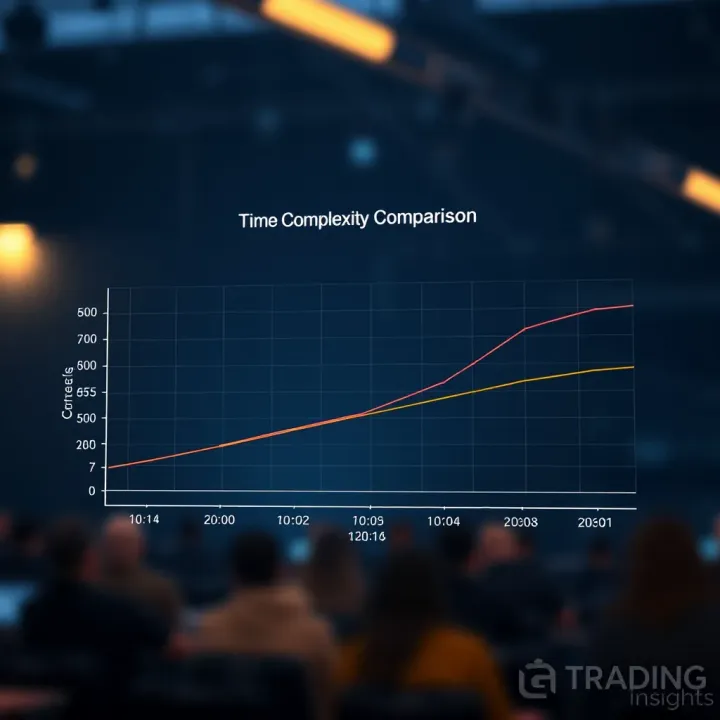
Binary search achieves a time complexity of O(log n). This logarithmic behaviour means that with every step, the amount of data to search is cut roughly in half. For example, searching a sorted list of one million entries requires about 20 comparisons, not a million.
In comparison, a linear search checks each item one after another, which results in O(n) time complexity. This distinction is critical for large datasets common in financial analysis and trading where quick lookups influence decision-making.
Binary search is efficient in space too. In iterative implementations, it operates with O(1) space complexity since it only uses a few variables. Recursive versions use O(log n) space due to call stack overhead, but this is often not a practical concern in most applications.
Understanding these complexities helps traders and analysts appreciate why binary search is preferred for fast data retrieval, especially when working with sorted financial time series, stock lists, or large databases. Its speed and low resource use make it a reliable tool in software and data-heavy tasks.
Next sections will compare binary search to linear search in detail and explore best, average, and worst-case scenarios to give a full picture of its behaviour in real-world uses.
Understanding how binary search operates is key to grasping why it remains a preferred algorithm for searching sorted data efficiently. By repeatedly dividing the search range, it optimises search time, especially for large data sets such as stock prices or large inventories in e-commerce platforms like Daraz.
Initial search range: When starting binary search, you set the search boundaries at the beginning and end of the sorted list. For example, if you have sorted monthly sales figures for a year, your range would be from the first month to the last month. This range directs where the algorithm looks for the target value.
Dividing the range: The technique halves the search range each time by identifying the middle element’s position. Using our sales figures example, if looking for July's sales data, binary search first checks the middle month (June or July depending on count), then narrows down to either the left or right half based on comparison.
Comparing middle element: This middle element acts as a checkpoint. The algorithm compares it to the target. If the middle value matches the target, search ends successfully. If it's higher, the search focuses on the lower half; if lower, it shifts to the upper half.
Adjusting search boundaries: Depending on the comparison, the algorithm adjusts the search range by moving either the start or end boundary past the eliminated half. This step continues until the target is found or the range collapses, signalling absence.
Sorted data requirement: Binary search works only if the data is sorted, whether alphabetically, numerically, or by date. For example, scanning a list of CNIC numbers in ascending order can be done with binary search, but an unsorted list demands sorting first or another method.
Random access to elements: Since binary search jumps directly to the middle element in each iteration, it requires data structures supporting random access like arrays or lists. Linked lists don’t suit this method well because accessing the middle is slow.
Iterative vs recursive approaches: Binary search can be implemented using loops (iterative) or function calls (recursive). Iterative methods use less memory and run faster, beneficial in environments with limited stack size, such as mobile apps in Pakistan. Recursive implementations, however, offer cleaner and more intuitive code, often preferred for teaching or in less constrained settings.
Mastering these basic concepts and conditions helps make binary search more than just a theoretical tool—it's a practical, efficient choice for handling large, sorted datasets in real-world applications.

Time complexity helps you understand how the performance of an algorithm like binary search changes as the amount of data grows. For traders or financial analysts working with large sorted datasets, knowing why binary search runs so efficiently is useful. It can save you time and computational resources, especially when analysing vast stock price lists or transaction records.
Binary search halves the search area with each step. Imagine you have a sorted list of 1,000,000 stock prices. On the first try, you check the middle price. If it doesn’t match, you eliminate half the list, so only 500,000 remain. The next step cuts it to 250,000, then to 125,000, and so forth. This repeated halving quickly zooms in on the target value.
This halving process means the number of steps required to find the item (or confirm it’s missing) increases very slowly compared to the size of the list. That’s why binary search scales well even for crores of records.
The number of comparisons grows proportionally to the logarithm of the input size. In practice, for a list of size n, binary search completes in approximately log₂ n steps. To put it simply, doubling the list size only adds one extra comparison. This contrast is stark compared to linear search, where doubling the list would double the time taken.
The quickest outcome happens when the element you want is exactly at the middle position in the initial check. This immediate match means the algorithm finishes in just one step. Though rare, this best case demonstrates how binary search can be lightning-fast if luck favours you.
For example, if a freelancer is searching their sorted payment history for a specific invoice that happens to be right in the middle, the lookup would be instant.
Usually, the algorithm takes several splits to locate the item or decide it doesn’t exist. The average and worst case both rely on how many times you need to halve the search range. Practically, this means performing roughly log₂ n comparisons.
For instance, searching in a sorted list of one lakh entries may need about 17 comparisons max. This is manageable even on modest hardware, making binary search suitable for applications from mobile apps in Karachi to server processes in Islamabad.
Mathematically, the time complexity of binary search is expressed as O(log n), where O denotes the upper bound on the number of operations. This logarithmic complexity explains why the search remains efficient even as datasets grow exponentially. It illustrates the remarkable advantage binary search holds over linear approaches, especially in large-scale Pakistani business or academic data.
Understanding these time patterns helps you pick the right search method and anticipate system loads in your projects or analyses.
Space complexity matters because it tells us how much extra memory an algorithm uses while running. For binary search, understanding space usage helps programmers choose between iterative and recursive methods, especially in memory-limited environments like older smartphones or low-end servers common in Pakistan.
Constant space usage means the iterative binary search only needs a fixed amount of memory regardless of the size of the data. It uses a few variables to keep track of the search boundaries (low, high, and mid). For example, searching through a sorted list of 1 million entries consumes nearly the same memory as searching among 100 entries.
This approach is practical for Pakistani developers who often run applications on devices with limited RAM, such as entry-level mobiles or budget laptops. The minimal memory footprint avoids extra strain on resources, allowing smoother performance during data lookups.
No extra data structures required reflects that the iterative version does not create new arrays or lists while searching. It simply moves pointers within the existing sorted data. This reduces overhead and keeps the process lean.
In real-world terms, apps like local e-commerce platforms or financial calculators performing binary search on sorted records benefit from this simplicity. It saves memory and avoids delays caused by additional data handling.
Stack space for recursion is a key consideration for the recursive binary search. Each recursive call adds a new frame to the call stack, consuming memory. Although each call only holds a few variables, the stack size grows with recursion depth.
For instance, finding an item in a large dataset with 1 million elements might involve up to 20 recursive calls (since log2(1,000,000) ≈ 20). Each call adds to memory usage, which is something to be mindful of in environments with tight memory limits.
Effect of recursion depth demonstrates that deeper recursion uses more stack space, increasing risk of stack overflow errors. In Pakistan, where many devices run older versions of operating systems or have lower hardware specs, this can cause apps to crash unexpectedly if not handled carefully.
Programmers may choose the recursive approach during development for its elegant code, but they often switch to iterative for production to avoid these practical problems. Understanding this helps avoid memory issues when working on software that handles large sorted datasets, such as database searches or inventory management.
In summary, the iterative binary search offers predictable, low memory use ideal for various Pakistani tech environments, while recursion demands cautious use because of its stack memory needs.
Comparing binary search with linear search helps clarify their strengths and weaknesses in different scenarios. Understanding these differences ensures you choose the most efficient method for your data or application—especially important when working with large datasets or in resource-constrained environments.
Time complexity contrast: Binary search has a time complexity of O(log n), meaning it reduces the search area by half every step. In contrast, linear search scans elements one by one, resulting in O(n) time complexity. For large datasets common in financial records or market data in Pakistan, binary search performs far quicker, making it ideal where data is sorted and access speed is vital.
When linear search may be preferable: Despite its slower average performance, linear search can be more practical when dealing with unsorted or small datasets. For example, a freelancer tracking a handful of client invoices on Excel may find linear search straightforward without the need to sort data beforehand. Also, linear search is simple to implement and use where writing complex code is impractical.
Examples in software applications used locally: Popular Pakistani apps like Bykea for deliveries or Careem often use binary search internally to quickly find available drivers near a location, as sorted location data enables rapid lookup. On the other hand, smaller-scale tools such as local accounting software or bookshops’ catalogues might rely on linear search for less structured data.
Practical considerations in data handling: When handling data like CNIC numbers or transaction histories, maintaining a sorted order supports efficient binary searches. However, frequent inserts or updates could slow sorting processes. In such cases, hybrid approaches, like first collecting data unsorted with linear methods and then sorting periodically, balance performance and ease. Remember, the choice depends on dataset size, update frequency, and resource limits common in many Pakistani offices.
Choosing between binary and linear search isn't just about speed but also the nature of your data and the environment in which the application runs. Efficient algorithms reduce wasted effort and improve user experience, especially in fast-moving sectors like trading or freelance projects.
In summary, binary search excels with sorted, large datasets demanding fast queries, while linear search fits simple or unsorted scenarios better. Pakistani professionals tackling data problems should weigh these factors carefully for optimal results.
Binary search may seem straightforward on paper with its logarithmic time complexity, but real-world factors often influence its actual performance. Understanding these factors helps developers and analysts make better decisions when applying binary search in practical scenarios, such as financial data analysis or software systems in Pakistan.
Large data sets directly impact how binary search performs under different conditions. When working with millions of records, say stock prices or transaction logs, the size of the data can slow down the algorithm because each access to the data costs time, especially if data is stored on disk rather than in memory. Though binary search reduces the number of comparisons drastically compared to linear search, the overhead of loading data into memory or caching plays a role too.
Apart from size, the way data is organised matters a lot. Binary search requires sorted data to function correctly, but some data storage structures enhance access speeds further. For instance, indexed databases or sorted arrays stored contiguously in memory offer faster random access, allowing binary search to operate close to its ideal speed. Conversely, if data is scattered or stored on slower mediums like HDDs or remote servers, the access time rises, slowing down the search despite the efficient algorithm.
Memory access speeds and hardware limitations directly influence binary search performance. Modern systems with high RAM speeds allow quick access to data in memory, improving search times. However, in environments where RAM is limited or data exceeds physical memory, page faults and swapping slow down the process.
In Pakistan, many users and businesses still rely heavily on mobile devices or low-spec servers, which face additional challenges. Devices under load, such as during network congestion or due to power fluctuations common in many areas, experience slower processing speeds. For example, a user searching through a large data set on a smartphone with limited RAM and processor capabilities might notice delays, even though the algorithm is optimised.
Understanding these practical influences ensures applying binary search thoughtfully rather than assuming theoretical efficiency alone. Developers targeting local markets should test performance under realistic hardware and data conditions to optimise efficiency.
This balance between theoretical algorithmic efficiency and real-world constraints often decides the true performance impact in software projects, especially where resources and infrastructure vary widely.
Large data sets increase physical data access costs, affecting binary search speed.
Organised, sorted data on fast-access mediums benefits binary search efficiency.
Memory speeds and hardware capability impact real-world binary search performance.
Pakistani mobile and server environments can introduce delays despite algorithm choice.
By weighing these factors, software engineers and analysts in Pakistan can build more responsive and efficient systems that leverage binary search to its practical fullest potential.
Explore the time ⏰ and space 🧠 complexity of binary search 🔍, understand why it's efficient, practical tips, and how it stacks against other search methods.

Learn how binary search works through clear pseudocode examples 🔍 Understand its logic, uses, benefits, and common mistakes. Efficient search made simple!
🔍 Dive into binary search time complexity 📊, exploring its best, average & worst cases, key differences from other methods, and tips for real-world search efficiency.

🔍 Learn how the binary search algorithm works with practical examples, why it’s efficient for sorted data, and how to implement it in your coding projects.
Based on 7 reviews