

Understanding 4-Bit Binary Adders and Their Uses
Explore the design and operation of 4-bit binary adders, including ripple carry & carry look-ahead versions, their applications, and key challenges ⚙️📊
Edited By
Amelia Price
Binary adders are the unsung heroes behind every digital device you tap, click, or swipe. At their core, they perform something quite simple—addition—but with binary numbers instead of the everyday decimal digits.
Why should you care? Whether you're a student starting out in electronics, a freelancer dabbling in embedded systems, or even someone curious about how your smartphone's processor crunches numbers, understanding binary adders is key. They are the building blocks for arithmetic operations in processors, impacting speed, efficiency, and reliability.

This article breaks down the basics of binary addition, walks through various types of adders like half adders, full adders, ripple carry adders, and more. Along the way, we’ll dive into their circuit designs and real-world applications.
Getting a grip on binary adders gives you a sharper insight into digital electronics, helping you design better systems and grasp how your devices process data under the hood.
Let's get started by exploring the nuts and bolts — the principle of binary addition — before unfolding the layers of different adder types and their practical uses.
Understanding the basics of binary addition is essential before diving into the mechanics of binary adders. Since digital electronics rely heavily on binary numbers, grasping how these numbers are added sets a strong foundation for further exploration. In everyday life, we usually add decimal numbers, but computers deal with binary digits—in simple terms, zeros and ones.
Having a clear understanding here isn't just theory; it impacts how processors perform calculations quickly and accurately. Knowing the nitty-gritty helps in troubleshooting errors or optimizing circuits, which can be a real asset for anyone working in tech or electronics.
The binary number system is a way to represent numbers using only two symbols: 0 and 1. This system is a cornerstone of digital computing because all electronic circuits inside computers recognize only two states—off and on, or low voltage and high voltage. For instance, the decimal number 5 converts to binary as 101, which means 1*(2^2) + 0*(2^1) + 1*(2^0).
This method might seem odd at first, but it's incredibly efficient for electronics. Each binary digit, or bit, directly relates to a physical switch that can be either closed or open. That direct mapping allows for reliability in processing and storing information.
In binary systems, the digit 0 usually stands for the absence of electrical charge or low voltage, and 1 stands for the presence of charge or high voltage. These two simple states make the foundation of all digital circuits. Understanding this helps one appreciate that the complexity of computers arises from manipulating countless 0s and 1s with speed.
Think of it like a light switch: off for 0, on for 1. Everything from text files to videos on your computer boils down to combos of these two states. When building binary adders, designers use these representations to create logic gates that perform arithmetic.
Adding single binary digits follows very straightforward rules:
0 + 0 = 0
0 + 1 = 1
1 + 0 = 1
1 + 1 = 10 (which means 0 with a carry of 1)
The last one is what distinguishes binary addition from decimal addition. Getting a carry here means the next significant bit has to account for an extra 1. For example, if you tried adding 1 (binary 0001) and 1 (binary 0001), the result is 10 (binary 0010).
These rules may seem simple, but they're the building blocks for more complex binary calculations vital to computer processes.
When two 1s add up, the carry must be moved to the left bit, just like how in decimal 9 + 1 carries over to the next column. This carry bit can trigger multiple cascades if the next bit is also a 1, which can slow things down in longer binary numbers.
For example, adding 111 + 1 results:
Add least significant bit: 1 + 1 = 10, so 0 with carry 1
Next bit: 1 + 1 + carry 1 = 11, so 1 with carry 1
Next bit: 1 + carry 1 = 10, so 0 with carry 1
A new bit 1 is added at the left
This shows how carry management is critical in binary addition. Efficient handling of these carries leads to faster computations, which is why many advanced binary adders focus on reducing carry propagation delay.
Tip: When you're breaking down how binary adders work, don't overlook carry logic—it’s the trickiest yet most interesting part.
By mastering these binary addition basics, you're well placed to better understand how various binary adders operate and why their designs matter in digital electronics and computing tasks. This knowledge also gives a practical edge if you're involved in programming, hardware design, or troubleshooting computer arithmetic issues.
In the world of digital electronics, a binary adder is a fundamental component that handles the addition of binary numbers. Think of it as the calculator inside a computer's brain, performing the basic arithmetic that powers everything from your smartphone apps to complex financial software. Knowing how binary adders work gives you insight into the nuts and bolts of computing processes.
Binary adders aren't just theoretical; they play a real role in making computations quicker and more efficient. For traders or financial analysts who use computers to run complex models, understanding the building blocks like adders can clarify why certain systems perform faster or handle bigger data loads better.
Simply put, the job of a binary adder is to take two binary numbers and sum them up. This might sound straightforward, but in digital circuits, even simple add operations involve careful handling of bits and carry values to ensure accuracy. The adder handles these bit-by-bit operations and combines the values correctly, much like adding numbers by hand but in electronic form.
A binary adder's core task is combining input bits and managing carry bits efficiently, which is key for arithmetic operations in any computing device.
Think of an adder like the cashier at a grocery store: they add prices together and give you the right total, including tax (carry). The difference is, binary adders perform millions of these calculations every second.
Binary adders pop up in a surprising number of places. They're essential in:
Processors: CPUs heavily rely on adders to perform arithmetic calculations.
Memory Addressing: When a computer fetches the next instruction or data bit, adders calculate addresses.
Digital Signal Processing: Here, adders help manipulate signals in audio, video, and communications.
Whether it's running a stock market simulation or managing data streams in real-time communication, binary adders are quietly behind the scenes making sure everything adds up.
At its core, a binary adder takes in two input bits—essentially 1s or 0s—representing the numbers it needs to add. Some adders also consider a carry-in bit if they're part of a larger, multi-bit addition task. These inputs are compared and processed through logic gates inside the circuit.
For instance, when adding two 4-bit binary numbers, the adder gets two bits from each number at a time, adding them together along with any carry from the previous addition.
The outputs of a binary adder are crucial to understanding how it fits into bigger arithmetic operations. It provides two outputs:
Sum (S): The direct result of adding the input bits, per position.
Carry (C): Indicates if an overflow occurred, meaning the sum exceeded the value a single bit can hold.
Imagine you add 1 + 1 in binary: the sum is 0 with a carry of 1. That carry moves over to the next higher bit position during multi-bit additions. This carry mechanism is what makes chaining adders together possible, paving the way for adding larger numbers reliably.
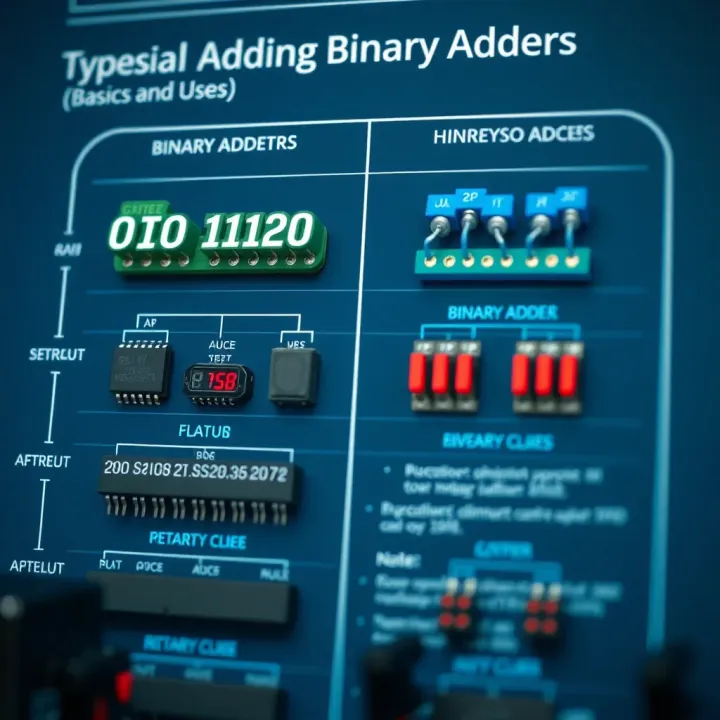
By managing inputs and outputs carefully, binary adders function as integral pieces in digital calculation, enabling everything from simple computations to complex algorithm executions.
Understanding the different types of binary adders is key when working with digital circuits or microprocessors. Each kind of adder offers specific advantages and suits certain tasks better than others. For instance, some focus on speed while others emphasize simplicity or reduced hardware usage. Knowing these distinctions lets engineers and hobbyists pick the right tool for the job, whether it’s a calculator, processor, or digital signal processor.
The half adder is the simplest type of binary adder. It adds two single binary digits and produces two outputs: sum and carry. Typically, it uses an XOR gate to calculate the sum (since XOR outputs 1 only when inputs differ) and an AND gate to determine the carry (which happens if both inputs are 1). This straightforward setup makes half adders useful for adding the least significant bits where no incoming carry is expected.
Half adders only process two input bits without considering any carry from a previous digit. This shortfall prevents chaining half adders alone to handle multi-bit binary numbers effectively. When you’re adding larger binary values, this missing piece means half adders can’t manage carry-over properly, leading to incorrect sums if used in isolation.
Unlike half adders, full adders can handle three inputs: two data bits plus an incoming carry bit. This addition allows full adders to correctly accumulate sums across multiple binary digits while considering previous carry-overs. Structurally, a full adder is often built by combining two half adders and an OR gate to merge carry signals.
By linking full adders in a chain, designers can build multi-bit adders capable of summing larger binary numbers, one bit at a time, passing carry bits along the chain. This setup is the groundwork for more complex adders found in CPUs and digital calculators.
The ripple carry adder is a straightforward extension constructed by cascading several full adders equal to the number of bits you want to add. Each full adder’s carry output ripples or feeds into the next full adder’s carry input. Imagine it like a line of people passing a message down one by one.
The simplicity of the ripple carry adder is a double-edged sword. While easy to build and understand, it slows down processing because each carry must wait for the previous one to finish. This carry
Building binary adders with logic gates is like constructing the engine of a car — it's the core that makes everything run smoothly. In the world of digital electronics, understanding how to piece together adders from basic logic gates not only clarifies how addition happens inside chips but also teaches practical design skills. Whether you're a student diving into electronics or a freelancer exploring embedded systems, knowing this can give you a leg up.
Logic gates like AND, OR, and XOR are the building blocks of digital circuits. When combined properly, they perform the addition of binary numbers bit by bit. This hands-on approach is crucial because it links theory to real-world circuits. It shows how simple truth tables translate into actual hardware that crunches numbers fast, powering everything from calculators to microprocessors.
The half adder is the simplest form of an adder circuit and is the starting point for building more complex adders. It takes two input bits and produces a sum and a carry-out bit. Here’s where XOR and AND gates step in:
The XOR gate handles the sum output. It gives a 1 when inputs differ and 0 when they’re the same, which perfectly matches binary addition without carry.
The AND gate generates the carry output, setting 1 only if both inputs are 1, signaling that a carry is needed to the next bit position.
Think of it like adding two digits without considering a previous carry. For example, adding 1 and 1 yields a sum of 0 and a carry of 1, which the XOR and AND gates handle flawlessly.
This implementation is straightforward but limited because it lacks the ability to factor in a carry input from a prior addition, which is where the full adder comes in.
Building on the half adder, the full adder includes a third input — the carry-in — enabling it to add binary numbers across multiple bits.
To design a full adder, two half adders are connected in sequence. The first half adder adds the initial two bits, while the second half adder adds the carry-in to the partial sum from the first. Here’s the flow:
First half adder processes inputs A and B.
Second half adder takes the sum from the first and the carry-in.
The final sum comes from the second half adder’s output.
This setup cleverly reuses the half adder design, keeping the circuit modular and easy to understand.
Handling the carry inputs properly is key to accurate multi-bit addition. In our full adder design, the outputs also include a carry-out bit that indicates if the next higher bit needs to be incremented. This carry-out is generated through an OR gate combining the carry outputs from both half adders.
This means the full adder not only calculates sum of three bits but also correctly propagates the carry to the next addition stage. For example, in a 4-bit adder, four full adders are cascaded, each passing its carry-out to the next full adder’s carry-in.
Understanding how to combine these basic gates into half and full adders provides the foundation to build more complex arithmetic circuits. It’s the nuts and bolts work behind every addition operation in digital systems.
In summary, implementing half adders using XOR and AND gates establishes the basics, and combining these half adders with carry inputs expands the capability to multi-bit binary addition. This stepwise construction mirrors real-life digital designs and is invaluable for anyone working with electronics or microprocessor-based projects.
When it comes to binary adders, performance isn't just a nice-to-have—it's what can make or break a design, especially in fast-paced computing environments. Whether you're building arithmetic units in CPUs or tackling real-time signal processing, understanding what affects a binary adder’s performance can help you make smarter design choices. This section looks at key performance factors such as delay and power consumption, explaining why they matter and how to manage them for better results.
One major bottleneck in binary addition is the delay caused by the carry signal moving from one bit position to the next. This carry propagation happens because, before a particular bit's sum is finalized, the adder sometimes needs to wait for the carry input from the previous bit, kind of like waiting for a baton in a relay race.
This delay can add up, especially in ripple carry adders where each bit’s output depends directly on the previous carry. For example, a 32-bit ripple carry adder might suffer noticeably longer delays compared to a smaller 8-bit adder.
To combat this, engineers use strategies to cut down delay times. One common approach is carry lookahead, where the logic predicts carry bits before waiting for previous sums to finish. This reduces wait times significantly but adds complexity in circuit design. Another tactic is parallel processing where different parts of the addition occur simultaneously, shaving precious milliseconds off the process.
Practical tip: When working with designs requiring speed, such as graphics processors or high-frequency trading systems, opting for faster adder architectures like carry lookahead or carry select is worth the extra design effort.
Power consumption is another key performance factor that impacts battery life in mobile devices and cooling requirements in high-performance servers. The way a binary adder is built directly affects its power usage.
Simpler designs like half adders and ripple carry adders consume less power due to fewer gates, but their slower speeds can indirectly cause inefficiencies if operations have to be repeated or pipelines stalled. Conversely, faster adders with complex gate networks may burn more power — it's like trading fuel economy for a fast car.
Designers often face a trade-off between speed and power. A carry lookahead adder might run quicker but consume more energy, which can be unsuitable for low-power applications like embedded systems.
Balancing this trade-off means picking the right adder type for your specific needs. For example, in a smartwatch, measuring power drain matters more than a slight speed gain, whereas a server CPU benefits more from rapid computation.
Understanding these nuances helps developers optimize circuits effectively, ensuring a good mix of performance and efficiency tailored to their applications.
Binary adders are more than theory tucked away in textbooks; they form the backbone of countless practical digital systems. Their ability to perform addition quickly and reliably makes them essential in everyday computing tasks, from running simple calculators to powering complex CPUs. Understanding where and how binary adders come into play helps demystify the inner workings of electronics that we often take for granted.
At the heart of any arithmetic logic unit (ALU), binary adders perform the wide range of arithmetic tasks from simple addition and subtraction to more complex operations like multiplication and division, all broken down into series of additions. When, for example, your calculator adds two numbers, it’s the binary adder circuits that do the grunt work behind the scenes by quickly summing the binary representations of those numbers.
These adders must be reliable and fast — even tiny delays add up when calculators handle many operations. By breaking down operations into smaller binary additions, the ALU makes calculations not just possible but efficient, enabling real-time responses in devices ranging from smartphones to industrial controllers.
In central processing units (CPUs), binary adders are pivotal components that handle everything from simple increment instructions to address calculations. Whenever the CPU adds two numbers, combines addresses, or calculates offsets, binary adders are the microscopic workers making it happen.
Embedding adders directly within the CPU pipelines helps speed up instruction execution. For example, Intel’s modern processors use complex carry lookahead adders among other designs to minimize delay, squeezing out extra performance without building physically bigger chips. This integration highlights the adder’s role not just as a standalone module but as part of the processor’s overall design that keeps computing smooth and snappy.
Digital signal processing (DSP) relies heavily on binary addition for manipulating data streams. Whether it’s compressing audio files, enhancing images, or filtering out noise, DSP chips perform thousands of additions per second to process signals accurately.
Binary adders help combine values, adjust signal amplitudes, and perform transformations by adding coded data efficiently. Take audio equalizers on your smartphone: in real time, they tweak frequencies by calculating new values via addition and subtraction operations done by binary adders.
One tricky part in DSP is the need for real-time processing, where delays can ruin the user experience—like video lag or distorted sound. Fast binary adders like carry lookahead or carry-save adders help reduce computational delays so signals are processed instantly.
By speeding up additions, these adder designs improve the DSP circuits’ ability to handle high volumes of data streams live, allowing technologies like voice recognition and video streaming to work seamlessly.
Binary adders also play a critical role in memory management by calculating addresses. When a program accesses data in memory, the CPU often needs to add base addresses with offsets to locate the right spot quickly.
This calculation relies on fast and accurate binary addition so that fetching or writing data doesn’t bottleneck the whole system. For example, virtual memory systems frequently update addresses in real-time, and adder circuits keep these operations efficient, impacting overall system responsiveness.
Binary addition underpins many error detection and correction schemes in digital communication and storage. By summing bits in specific ways, devices identify inconsistencies signaling errors and trigger mechanisms to fix them.
For instance, in parity checks or cyclic redundancy checks (CRC), the process involves adding bits and comparing sums to expected values. Binary adders perform these sums swiftly, helping maintain data integrity across noisy communication channels or faulty storage.
In everyday electronics and high-tech systems alike, binary adders quietly ensure accuracy, speed, and reliability. They’re not just about adding numbers but enabling the whole digital world’s operations.
Designing efficient binary adders is no walk in the park. As these circuits get larger and more complex, a handful of challenges pop up that designers have to wrestle with. From balancing the physical size on a chip to managing the slipping speed caused by electrical delays, these hurdles directly affect the performance and feasibility of digital systems. Understanding these challenges is essential, especially for students and professionals dabbling in electronics or computing, since it shapes how modern processors and gadgets handle operations. Without addressing such issues, even a technically correct adder design could end up sluggish or bulky, failing the needs of real-world applications.
Balancing size and speed is a fine art in adder design. Shrinking a circuit to save space often means using fewer logic gates, but this can slow down computation because the signal has to pass through several gates sequentially. Conversely, speeding things up might require more gates and parallel pathways, eating up valuable silicon real estate and power. For example, a Ripple Carry Adder is simple and compact but slow due to carry signals moving bit by bit. On the other hand, a Carry Lookahead Adder speeds things up by predicting carries in advance but demands more circuitry.
In practice, designers must weigh these trade-offs based on what matters most. For handheld devices where battery life and size are king, a smaller circuit might win despite minor speed hits. For servers processing millions of calculations, faster adders justify the extra few square millimeters. Achieving this balance is vital because it touches the cost, power efficiency, and heat production — factors that directly influence device operation and lifespan.
As the number of bits jumps—for instance, moving from 8-bit to 64-bit adders—the design complexity doesn't just grow; the issues multiply, especially propagation delay. This delay happens because each bit’s carry must ripple through all the preceding bits before final results lock in. Imagine the frustration of waiting for traffic to crawl through a one-lane road full of cars; that's what happens electrically when too many bits force a long chain of delays.
To tackle this, designers have come up with several design adaptations. One clever approach is the Carry Lookahead Adder, which speeds up addition by figuring out carry signals ahead of time instead of waiting for ripple effects. Another is the Carry Select Adder, which computes sums for carry-in values of 0 and 1 in parallel, switching to the right result instantly once the carry input is known.
Additionally, hierarchical designs break large adders into smaller blocks combined strategically. Instead of a single long ripple, multiple carry lookahead blocks operate simultaneously, slicing the problem into manageable parts. Such adaptations let chip makers handle wider bit operations without bogging down processors or inflating chip sizes too drastically.
With the rapid growth of data and processing demands, effectively managing complexity and scaling in binary adders isn’t just academic—it's the backbone of faster and more efficient digital devices.
In the end, understanding these challenges and solutions equips students and professionals alike to make smarter design choices, ensuring binary adders serve well in everything from smartphones to financial calculators, all handling numbers with speed and accuracy.
Wrapping up, this section ties together everything we've talked about regarding binary adders, pointing out why these tiny yet powerful circuits matter so much in digital electronics. Understanding their mechanics, types, and real-world uses isn't just academic; it's the backbone for anyone working with or designing digital systems. Plus, looking ahead hints at how advances could impact fields like computing and embedded systems in the years to come.
Fundamentals and types: Binary adders are at the heart of basic arithmetic in computers, dealing with the addition of binary numbers. The most common types we covered include half adders, full adders, ripple carry adders, and carry lookahead adders. Each type balances complexity and speed differently—half adders are simple but limited to single-bit addition, while carry lookahead adders speed up the process by handling carries more efficiently. Getting to know these helps you pick the right adder circuit for your specific needs, be it for a small embedded device or a high-speed processor.
Design factors and applications: When designing binary adders, factors like delay, power consumption, and circuit complexity must be balanced carefully. For example, ripple carry adders are straightforward but slow as the number of bits increases, while carry lookahead adders handle speed better at the expense of design complexity and power use. These considerations directly affect how adders perform in devices such as CPUs, digital signal processors, and memory units—areas where both speed and efficiency truly matter.
New materials and methods: Research isn’t standing still. Silicon isn't the only game in town anymore. Materials like graphene and gallium nitride are gaining interest because they can potentially speed up switching times and reduce power loss. Also, design strategies such as approximate adders, which allow small errors to cut down on delay and power, are being tested, especially for applications where perfect accuracy isn't mission-critical, like multimedia processing.
Impact on computing performance: These advances could seriously shake up computing speed and efficiency. Faster adders mean CPUs can handle more calculations per second, improving everything from gaming to financial modeling. Lower power usage helps mobile devices last longer and keeps data centers cooler. For example, Intel and AMD are continually refining their arithmetic units to squeeze out better performance per watt, crucial in today’s world where energy costs and thermal limits constrain hardware.
Getting a grip on binary adders not only clears the fog around digital arithmetic but also opens doors to smarter design choices, whether you’re coding, engineering, or investing in tech.
In summary, having a strong foundation on binary adders equips you to grasp current technology and anticipate future shifts that will influence the digital tools all of us rely on.
Explore the design and operation of 4-bit binary adders, including ripple carry & carry look-ahead versions, their applications, and key challenges ⚙️📊

💻 Explore how binary data forms the core of computing, its storage techniques, and practical uses in tech. A clear guide for anyone curious about computer basics.
Explore how binary logic powers computing and electronics 🔍 Learn about logic gates, digital systems, history, and practical tech applications in Pakistan 🇵🇰

Explore binary digits💻: their basics, history, and how they power computing systems and everyday tech📱. Understand binary ops and practical uses clearly.
Based on 14 reviews