

Binary Division Rules and Their Practical Uses
Learn binary division rules with clear examples and methods ⚙️. Compare binary & decimal division and explore real-world uses in computing 💻 and digital tech.
Edited By
Ethan Gallagher
Binary trees are a fundamental data structure in computer science, widely used in programming and algorithm design. At its core, a binary tree is made up of nodes, each having at most two children—often termed as the left and right child. This simple structure supports efficient searching, insertion, and deletion operations, making it invaluable for many practical applications.
Understanding the basic properties of binary trees helps optimise code and solve problems more effectively. Key attributes include height, which is the longest path from the root node to a leaf, and depth, the distance of a node from the root. Balancing these elements impacts performance, especially in search and sort functionalities.
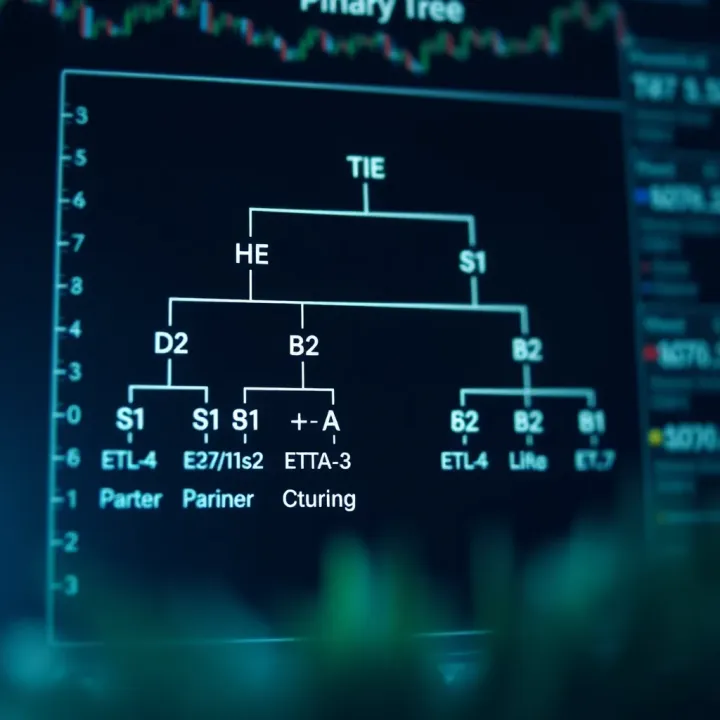
For example, unbalanced trees can degrade search times from logarithmic to linear. Balanced binary trees like AVL or Red-Black Trees maintain height where operations generally take O(log n) time, where n is the number of nodes. This becomes crucial when working with large datasets, such as in financial software analysing stock prices or in ecommerce platforms like Daraz for sorting products.
Traversal methods—such as inorder, preorder, and postorder—determine the order in which nodes are accessed or processed. These techniques are not just academic; they find real-world use in scenarios like parsing expressions, managing priority queues, or directory structures in file systems.
Efficient data handling often boils down to knowing these properties well. Pakistani students and developers can leverage this knowledge to build more efficient algorithms for everything from tax calculations to automated trading.
Common types of binary trees include:
Full Binary Tree: Every node has 0 or 2 children.
Complete Binary Tree: All levels except possibly the last are fully filled.
Perfect Binary Tree: All internal nodes have two children and all leaves are at the same level.
Recognising these types helps in picking the right structure for your programming task, ensuring both speed and resource efficiency.
In the following sections, we'll dive deeper into these properties and practical applications, making binary trees accessible and relevant for you, whether you're a student preparing for computer science exams or a developer working on real-world projects.
Binary trees form the foundation of many computer algorithms and data structures, thanks to their simple yet versatile nature. Understanding the basics, including their structure and terminology, is key to grasping how they work and why they matter. Whether you're working on database indexing, expression parsing, or even file systems, the fundamentals of binary trees help you design efficient solutions.
A binary tree consists of nodes connected by edges. Each node holds data, and edges represent the connection or relationship between these nodes. Think of a family tree — every person (node) is connected to others through relationships (edges).
In practical terms, a node could store anything from a number to a complex data object. Edges define the path you take from one node to another, guiding traversals and searches efficiently. For example, in a search algorithm, edges show how you move from one point to another to find your target.
The root is the starting point of the binary tree — it has no parent. Every other node has exactly one parent but can have up to two children. This parent-child dynamic shapes how the tree grows and how data flows within it.
For example, in a sorted binary search tree, the parent node decides whether the child falls to the left or right depending on its value. This relationship is essential for organising data, making searching much faster than scanning a list.
Leaf nodes are nodes without children. They represent the endpoints in the tree structure. Practically, leaf nodes often hold the final data elements you want to access or process.
Consider a directory structure on your computer: files with no further folders inside act like leaf nodes. Understanding leaf nodes helps when calculating tree depth or pruning unwanted data paths.
Internal nodes have at least one child node. These nodes act as junction points where decisions or splits occur in the data.
In algorithm design, internal nodes often represent intermediate processing steps. For instance, in a decision tree used for predictions, internal nodes contain questions or conditions that guide you to the correct leaf node.
Subtrees are smaller trees within a larger binary tree, starting at any node and including all its descendants. You can treat each subtree independently for operations like insertion, deletion, or traversal.
For example, when you balance a binary tree or perform recursive operations, you work with subtrees one at a time. Recognising subtrees helps in breaking down complex problems into manageable parts.
Understanding these basics is crucial before moving on to advanced properties and applications of binary trees. They form a language to communicate about tree structures with precision and clarity.
Nodes hold data, edges link them.
The root is the starting node; every node except root has one parent.
Leaf nodes have no children; internal nodes have one or two children.
Subtrees are portions of the tree rooted at any node.
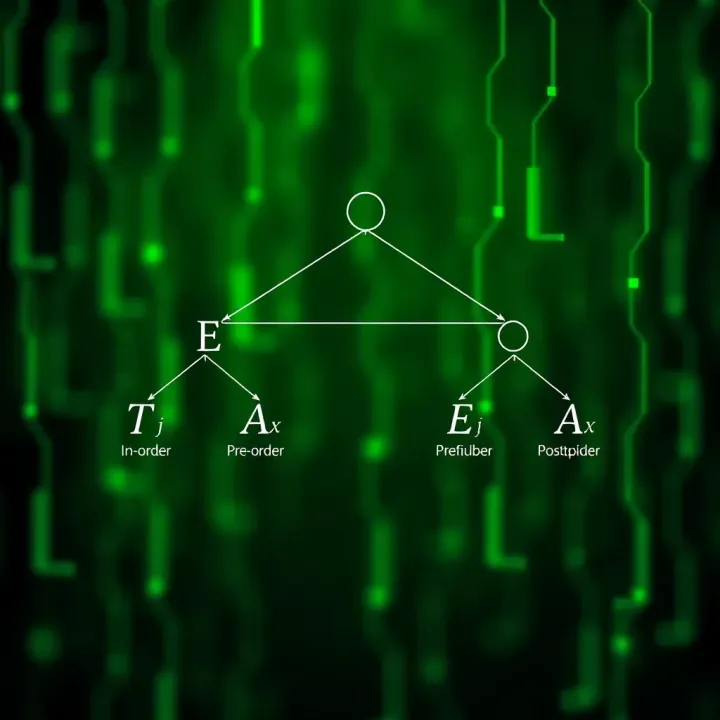
These core ideas underpin everything else, from traversal techniques to tree balancing methods, and are especially useful for developers and students working on practical coding problems or system design.
Understanding the core properties of binary trees is essential for anyone working with data structures in programming or analysing algorithm performance. These properties shed light on how binary trees organise data, how efficiently they can operate, and how their design impacts tasks like searching, insertion, and traversal. For example, grasping how many nodes a level can have helps predict the memory or processing power needed at different stages of tree operations.
Each level of a binary tree can have up to twice the number of nodes as the level before it. Specifically, the maximum nodes at level l is (2^l) where the root is at level 0. For instance, the first level after the root (level 1) can hold up to 2 nodes, the second level up to 4, and so on. This exponential growth means that binary trees become wider quickly as you move down levels.
This property matters because it directly affects memory usage and computational complexity. In situations like database indexing or file system structures, knowing the theoretical maximum nodes at each level helps you estimate worst-case scenarios for storage or search time.
A complete binary tree is one where all levels except possibly the last are fully filled, and all nodes are as far left as possible. The total number of nodes N in such a tree can be calculated with the formula (N = 2^h+1 - 1), where h is the tree's height.
For example, if a complete binary tree has height 3, then the total nodes are (2^4 - 1 = 15). This formula provides a reliable benchmark for programmers to verify whether a tree structure is complete. In practical terms, complete binary trees are used in heaps, which power priority queues—common in resource scheduling, like process management in operating systems.
The height of a binary tree is the length of the longest path from the root node to a leaf node. It’s typically measured by counting edges, starting from zero at the root. The height affects performance directly; for example, searching or inserting data in a tree usually requires time proportional to the tree's height.
In practice, a binary tree with height h provides a worst-case scenario of searching through h nodes. Thus, keeping the tree’s height minimal is crucial in cases like binary search trees used in databases.
Depth, on the other hand, refers to how far a particular node is from the root. The root node has depth 0, its children depth 1, and so on. Understanding depth helps in operations like balancing the tree or implementing traversal algorithms.
Suppose you’re dealing with a large directory structure on your computer. The depth tells you how nested a folder is inside the main directory. Similarly, in coding terms, knowing node depth aids in quickly locating or updating nodes, especially when the tree structure changes dynamically.
Knowing the height and depth in a binary tree not only clarifies its structure but also guides optimisation for search and data management tasks.
By studying these core properties, developers and students can better design and work with efficient binary tree structures for a variety of applications, from managing data in software to handling complex decision-making algorithms.
Understanding binary tree types is key to applying them effectively in programming and algorithms. Each type brings its own structure and benefits, influencing performance and ease of use. Let’s look at the common types: full, perfect, complete, balanced, and skewed binary trees.
A full binary tree is one where every node has either zero or two children, never just one. For example, in a family tree of three generations, if each parent has exactly two children, the tree is full. This strict structure helps in simplifying tree traversal algorithms.
A perfect binary tree takes this a step further: all internal nodes have two children, and all leaf nodes exist at the same level. It means the tree is completely filled. Such trees are commonly used in heap data structures, where balanced access time is crucial.
A balanced binary tree keeps its heights of left and right subtrees nearly equal, which is measured via the balance factor—the difference in heights. Usually, a balance factor of -1, 0, or 1 at every node indicates good balance. This balance prevents the tree from becoming skewed, which can degrade performance.
Balanced trees like AVL trees are important because they allow operations like search, insert, and delete to run in O(log n) time. In practical terms, it means even with millions of entries, retrieval stays fast, which is essential for databases or real-time searches.
In a balanced tree, insertions also maintain the balance by rotations or restructuring. This upkeep ensures that adding new nodes does not turn the tree into a linked list, which slows down operations. For instance, if you're using a balanced binary search tree to store employee records, searches won’t slow even as the organisation grows.
Maintaining this integrity demands extra processing during insertions and deletions, but it prevents worst-case scenarios where performance drops severely. This trade-off is often worth it for time-sensitive applications.
A skewed binary tree is one where all nodes have only one child, either to the left or right. Left-skewed trees look like a descending chain leaning left, with each node linking to a left child only. Right-skewed trees mirror this on the right side.
Such structures often occur when data is inserted in sorted order without rebalancing. For example, inserting increasing student ID numbers into a plain binary search tree without balancing will create a right-skewed tree.
Skewed trees behave like linked lists, causing search, insert, and delete operations to degrade to O(n) time. This linear complexity is a big hit for large datasets, making skewed trees inefficient.
To avoid this, balanced trees or self-adjusting trees like splay trees are favoured. Still, recognising skewed trees helps diagnose performance issues in existing systems and guides the choice of suitable data structures.
Proper understanding of binary tree types explains why certain structures are faster or slower, which is critical when building efficient software. Balanced trees typically deliver the best all-round performance in diverse real-world scenarios.
This section sheds light on how knowing and using the right binary tree type can save resources and time, especially as datasets grow. Pakistani developers and students can apply these insights directly in assignments, tech interviews, and software projects for better results.
Traversal in binary trees means visiting each node in a specific order. This process is essential because it allows us to access or modify tree data systematically. Different traversal methods serve distinct purposes, depending on the problem you're solving. For instance, database indexing or file system navigation on a computer may use specific traversals to optimise speed and memory.
These are depth-first traversal techniques. In in-order traversal, you first visit the left subtree, then the node itself, and finally the right subtree. This method is especially useful in binary search trees (BST), as it results in nodes being accessed in ascending order. For example, if you have a BST of stock prices, an in-order traversal allows you to list prices from lowest to highest.
Pre-order traversal visits the current node before its subtrees: node first, then the left subtree, and finally the right subtree. This traversal helps in copying the tree or in scenarios where you must save the tree structure. It is also handy for prefix expression evaluation in expression trees.
Post-order traversal processes all subtrees first before visiting the node itself: left subtree, right subtree, then node. This order suits cases where you want to delete or free nodes safely, such as clearing memory. Post-order traversal also helps in evaluating postfix expressions.
Unlike depth-first traversals, level-order traversal is a breadth-first approach. Here, nodes are visited level by level, starting from the root and moving down to the leaves. This method is critical when you need to understand the structure layer-wise—for example, in network broadcasting or generating snapshots of hierarchical data.
In practical terms, level-order traversal uses a queue to track nodes. This makes the process more memory intensive than in-order or pre-order methods but useful when applications require processing nodes in the order of their depth.
Traversal choice directly impacts performance and application logic. While in-order is best for sorted data retrieval, pre-order and post-order suit structural operations, and level-order suits scenarios needing a top-down perspective.
Understanding these traversal techniques enables you to pick the right approach for tasks like optimising search algorithms, managing hierarchical data, or implementing complex operations in Pakistani tech projects or software development tasks.
Understanding the practical side of binary tree properties is essential because it directly affects how efficiently data is stored and accessed. In many real-world applications—from database indexing to network routing—binary trees provide the backbone for organising data in a way that saves time and computing resources.
Binary trees help organise data so that lookups, insertions, and deletions happen quickly. For example, a balanced binary tree ensures that the maximum depth from the root to any leaf is minimised, which keeps operations like searches running in logarithmic time. This matters particularly when working with large datasets, such as customer records in a bank or transaction histories on an e-commerce platform like Daraz.
Consider a contact list on a smartphone that uses a binary tree structure. When you search for a name, the tree helps navigate quickly through contacts instead of checking each entry one by one. If the tree becomes unbalanced, the search could degenerate into a linear scan, which wastes time and battery life—a major concern for mobile users.
A binary search tree (BST) stores elements in a way that the left child contains smaller values, and the right child holds greater ones. This organisation allows quick searching, insertion, and removal of data. In banking software or stock trading systems, BSTs enable fast lookup of account balances or stock prices. However, the efficiency depends on keeping the tree balanced; otherwise, performance drops.
For Pakistani developers working on financial apps or inventory management, understanding the BST’s structure helps design systems that respond fast even under heavy load. For instance, during high traffic times, like the days leading to Eid when many shop on online platforms, a well-balanced BST avoids delays system-wide.
Heaps are special binary trees used mainly in priority queue implementations. They maintain a property where the parent node is either greater (max-heap) or smaller (min-heap) than its children. This makes them ideal for scheduling tasks or managing resources—for example, Careem might use a heap to assign drivers based on priority factors like proximity or ratings.
In addition, heaps play a big role in sorting algorithms with efficient time complexity, such as heap sort. This is useful when you want to order large amounts of data, like sorting client lists or financial transactions. Because heaps allow quick access to the highest or lowest element, they’re preferred in scenarios that require constant updates and prioritisation.
Knowing how these binary tree properties impact performance gives developers the edge in designing and maintaining responsive, reliable systems—especially in Pakistan's diverse range of tech sectors, from fintech to logistics.
Learn binary division rules with clear examples and methods ⚙️. Compare binary & decimal division and explore real-world uses in computing 💻 and digital tech.

Explore how binary parallel adders work in digital circuits ⚙️! Learn their design, operation, and key uses in computing systems for efficient performance 🖥️.

Explore how binary numbers operate in tech 📱, understand binary vs decimal, and learn key binary operations powering today's digital devices 💻.

Explore how binary logic powers computing and electronics 🔍 Learn about logic gates, digital systems, history, and practical tech applications in Pakistan 🇵🇰
Based on 8 reviews